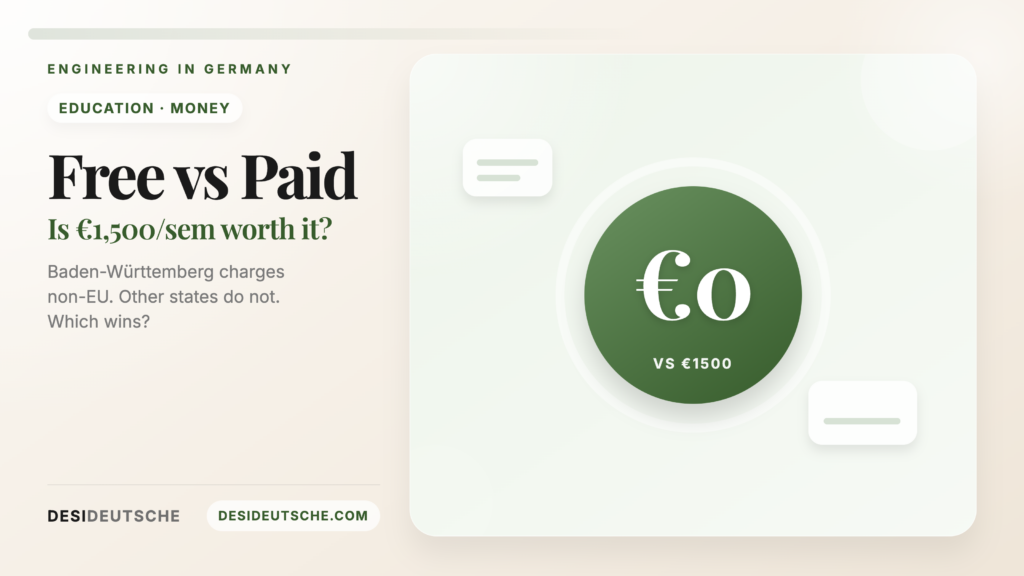
“Germany is free” is the headline every Indian student hears. The truth is more specific: 15 of Germany’s 16 federal states are tuition-free for international students. The 16th — Baden-Württemberg — charges €1,500 per semester for non-EU students. That’s €6,000 over a 2-year Master’s. So: is a Baden-Württemberg university (KIT, Stuttgart, Mannheim, Heidelberg, Freiburg) worth the extra money, or should you pick a free alternative?
TL;DR: €1,500/sem is real. €6,000 extra over a Master’s. For most programs, a free TU9 alternative exists that is equally good. Pay for Baden-Württemberg only when the specific program or industry connection is unique — KIT for AI, Stuttgart for automotive, Heidelberg for molecular biology.
Which German states charge tuition?
Only Baden-Württemberg charges non-EU tuition (€1,500/semester) as of 2026. Bavaria briefly charged in the 2010s and abolished it. All other 14 states — Berlin, Bremen, Hamburg, Hessen, Mecklenburg-Vorpommern, Niedersachsen, Nordrhein-Westfalen, Rheinland-Pfalz, Saarland, Sachsen, Sachsen-Anhalt, Schleswig-Holstein, Thüringen, and Brandenburg — charge no tuition.
Which universities are in Baden-Württemberg?
- KIT (Karlsruher Institut für Technologie) — elite for CS, engineering, energy
- Universität Stuttgart — automotive capital
- Universität Mannheim — Germany’s top business school
- Universität Heidelberg — oldest, strong in sciences and medicine
- Universität Freiburg — environmental sciences, medicine
- Universität Tübingen — humanities, neuroscience
- Hochschule Esslingen, HS Karlsruhe, HS Mannheim — applied sciences
What exactly is €1,500?
The €1,500 is the non-EU international tuition fee introduced in 2017. It is in addition to the regular semester contribution (~€150–250) that every student pays. So your total cost per semester at a Baden-Württemberg university is roughly €1,650–1,750. Over 4 semesters of a Master’s → ~€6,800 total.
Free alternatives to every Baden-Württemberg university
| Instead of (€1,500/sem) | Consider (Free) |
|---|---|
| KIT (Computer Science) | TUM, RWTH Aachen, TU Berlin, TU Darmstadt |
| KIT (Mechanical) | TUM, RWTH Aachen, TU Darmstadt, LU Hannover |
| Uni Stuttgart (Automotive) | TU Braunschweig, TUM, TU Darmstadt |
| Uni Mannheim (Business) | Goethe Uni Frankfurt, HU Berlin, LMU |
| Heidelberg (Life Sciences) | LMU Munich, FU Berlin, TUM |
| HS Esslingen (Automotive FH) | Hochschule München, HS Ingolstadt |
When paying is worth it
- KIT for AI / Robotics: Its KIT-AI research institute and industry pipelines are hard to replicate.
- Stuttgart for Automotive: Mercedes-Benz, Porsche, Bosch are headquartered in the Stuttgart region — the geographic access to internships is unmatched.
- Heidelberg for Biomedicine: The EMBL and DKFZ research ecosystem is unique in Germany.
- Mannheim for Business/Economics: Best business school brand in Germany, strong consulting pipeline.
When paying is NOT worth it
- When the same program exists at TUM, RWTH, TU Berlin, or TU Darmstadt for free.
- When your target career is research / academia — TU9 universities outside BW are equally recognized.
- When you are tight on budget — €6,000 is 15 months of living expenses in a non-Munich city.
Hidden cost factors beyond tuition
Tuition is just one number. Compare living cost + tuition — which is often a bigger factor than the fee itself.
| City | Tuition/sem | Rent (WG) | Total monthly |
|---|---|---|---|
| Karlsruhe (KIT) | €1,500 | €400 | ~€900 + €250 tuition amortized |
| Stuttgart | €1,500 | €550 | ~€1,050 + €250 |
| Munich (TUM) — free | €0 | €700 | ~€1,250 |
| Aachen (RWTH) — free | €0 | €400 | ~€900 |
| Berlin (TU) — free | €0 | €550 | ~€1,050 |
| Dresden (TU) — free | €0 | €350 | ~€850 |
How to pay the €1,500
Tuition is paid each semester, usually by SEPA bank transfer from your German account once you arrive. It is included as a visa finance consideration — the blocked account requirement is the same regardless of tuition (€11,904 for the year).
The verdict
If you get into KIT for AI, Stuttgart for automotive, or Mannheim for business — pay the €1,500. The career compounding is worth it. For every other program, a free TU9 alternative exists that is equally strong. Do not pay for brand when a free equivalent is on the table.
? Free: First 90 Days in Germany — Complete Checklist
Every task in order. Print it, use it, share it.
Frequently Asked Questions
Is a German Master’s really free for Indians?
Yes, in 15 of 16 states. Only Baden-Württemberg (KIT, Stuttgart, Heidelberg, Mannheim, Freiburg) charges non-EU students €1,500/semester. Every other state is tuition-free.
What is the semester fee if tuition is free?
Even at free universities, you pay a semester contribution of ~€150–350, which covers student services, administration, and usually a public transport ticket for the semester.
Does the €1,500 include the Deutschlandticket?
No, but Baden-Württemberg universities have a separate semester ticket for regional transport, typically €80–150 per semester.
Can I get a refund of the €1,500 if I drop out?
Partial refund is possible if you deregister before the semester start. After the semester begins, the fee is usually non-refundable.
Do scholarships cover the €1,500 tuition?
DAAD scholarships cover tuition fees. Deutschlandstipendium covers €300/month toward living costs but not tuition directly. University-specific scholarships vary.
Will more states start charging tuition?
There is no announced plan as of 2026, but Bavaria’s previous experiment (2007–2013) shows it’s politically possible. Check state-specific rules at application time.
Next in the series