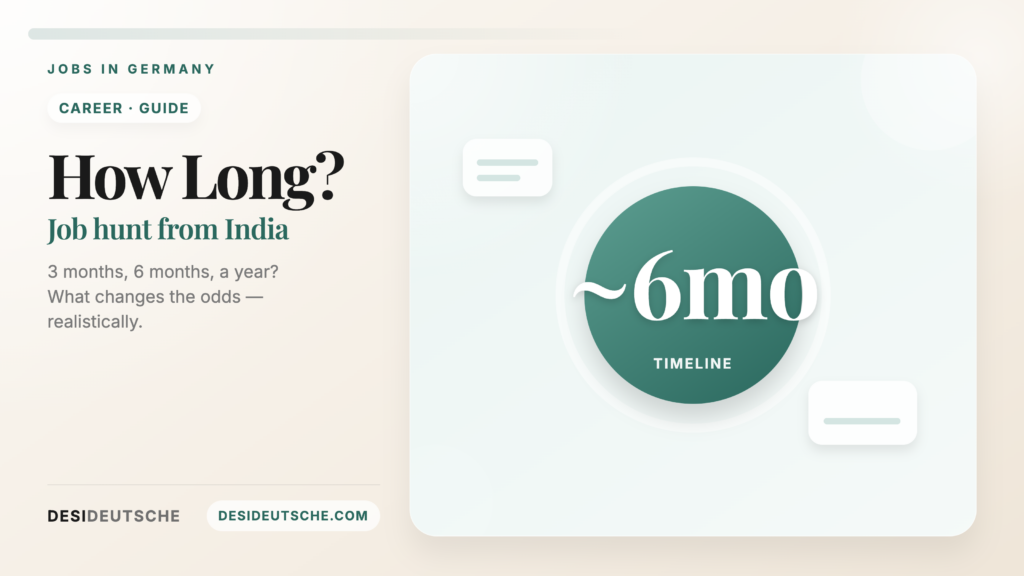
The honest answer — most Indian tech professionals take 4 to 9 months to land a Germany-based offer while still in India. The wide range is not random. It’s driven by a handful of specific factors you can actually control. This post breaks down the realistic timeline and what shortens it vs stretches it.
TL;DR: Median: 6 months. Fastest: 2–3 months (if you have a strong referral or work at a global company transferring internally). Slowest: 12–18 months (if cold-applying without EU experience or a recognized degree). Your CV format and application volume matter more than your skill level.
The median timeline — broken down
| Phase | Duration | What you’re doing |
|---|---|---|
| Preparation | 2–4 weeks | German CV, LinkedIn rework, target company list, cover letter template |
| Active application | 10–16 weeks | Submitting 40–150+ applications |
| Interviews | 2–6 weeks | First round → technical → final → HR → offer |
| Offer to visa | 6–12 weeks | VFS appointment, document prep, visa interview |
| Total | 5–10 months |
What shortens the timeline
- Internal transfer at a global company: SAP Labs India → Walldorf, Amazon Bangalore → Berlin, Google India → Munich. 2–4 months if you already work there.
- Strong referral: One Indian friend inside SAP/Bosch/Siemens referring you cuts screening by 50%. Callback rates 5× higher.
- In-demand niche skill: Kubernetes, ML engineering, SAP ABAP, Embedded C for automotive — these roles have candidate shortages.
- German language ability: B1+ doubles your eligible role count. B2 triples it.
- Degree from IIT/NIT/BITS/top tier: Faster initial screening. Doesn’t change final decisions much.
- Already an EU Blue Card holder elsewhere: If you have a Blue Card from another EU country, intra-EU mobility kicks in.
What stretches the timeline
- Cold applying without referrals: 50–100+ applications to get 3–5 callbacks is normal.
- Non-anabin-recognized degree: Adds 3–4 months for ZAB evaluation.
- Non-IT / non-engineering field: Finance, marketing, HR — the English-only pool is small, timeline stretches to 12+ months.
- Weak CV formatting: Indian resume format → 1–2% callback rate. German format → 4–6%.
- Applying only through LinkedIn Easy Apply: Lowest-signal channel. Use company career portals directly.
Where to actually apply
- StepStone.de — largest German job board.
- LinkedIn — strong for tech roles, but company-direct is better.
- Xing.de — German-market equivalent to LinkedIn. Mittelstand companies post here.
- Indeed.de — broad, includes Mittelstand roles.
- Make-IT-in-Germany.com — official government portal, curated roles for international applicants.
- EURES — European public employment network, relocation-friendly employers.
- Glassdoor Germany — for salary benchmarking and company ratings.
- Company career portals — SAP, Siemens, Bosch, BMW, Mercedes-Benz, Volkswagen, Zalando, Trivago, N26, etc. Apply direct.
Realistic application volume
For a typical Indian tech professional with 3–5 years of experience, expect:
- 100 applications → 8–12 responses → 3–5 interviews → 1–2 offers.
- 150 applications → 15–20 responses → 6–8 interviews → 2–3 offers.
- Target 3–5 applications per day, 5 days a week until you start getting interviews.
The interview process — what to expect
- Screening call (HR, 30 min): Motivation, CV, expected salary, visa status.
- Technical interview (60–90 min): Coding, system design, or role-specific questions.
- Team / hiring manager interview (60 min): Behavioral + deeper technical.
- Final / leadership interview (30–60 min): Culture fit, senior stakeholder.
- HR closeout (30 min): Offer details, start date negotiation.
German processes are usually slower than US/Indian ones. 3–4 weeks from first call to offer is typical. 6–8 weeks is not unusual.
The visa timeline after offer
- Document prep: 1–2 weeks (degree attestation, photos, forms, APS check).
- VFS appointment booking: 4–12 weeks wait depending on city.
- Visa interview: Usually same day or next day as appointment.
- Visa decision: 3–8 weeks after interview.
- Travel: Within validity of your D-visa (usually 3 months from issue).
A realistic 6-month plan
Assuming you start preparing today:
- Month 1: Rewrite CV (German format), update LinkedIn, research 30 target companies, write 1 strong cover letter template.
- Month 2: Submit 80+ applications. Activate referrals aggressively (LinkedIn alumni search, ex-colleagues abroad).
- Month 3: 5–10 interviews in progress. Prepare technically. Reply quickly to recruiters.
- Month 4: Final rounds, offer negotiation, sign contract.
- Month 5: Document prep, book VFS, attend interview.
- Month 6: Visa received, flight booked, relocation imminent.
📋 Free: First 90 Days in Germany — Complete Checklist
Every task in order. Print it, use it, share it.
Frequently Asked Questions
How many applications does it take to get a job in Germany from India?
For experienced tech professionals, 80–150 applications typically yield 2–3 offers. Less experienced applicants or those without German often need 200+.
Is it faster to apply while already in Germany on a job seeker visa?
Yes. Being physically present in Germany shortens the hiring timeline by ~40% because employers worry less about relocation delays. Onsite interviews are possible.
Can I get a job in Germany in 3 months?
Only with a strong referral, internal transfer, or in-demand niche skill. For most cold applicants, 3 months is too ambitious — 5–7 months is realistic.
Do Indian tech recruiters help with Germany job hunt?
Some do — usually for big firms like TCS, Infosys relocations. For direct placement at German companies, German-based recruiters (Randstad, Hays, Michael Page) are more effective.
Should I use LinkedIn Easy Apply?
No. It’s the lowest-signal channel. German recruiters see far too many Easy Applies and filter them heavily. Apply through company career portals directly.
Is the hiring process slower in Germany than in the US or India?
Yes. Typical German processes take 4–8 weeks from first interview to offer vs 2–3 weeks in the US. Startups are faster, Mittelstand companies are slower.
What time of year is best for job hunting in Germany?
January–March and September–November are peak hiring seasons. Avoid July–August (summer holidays) and mid-December to early January (Christmas slowdown).
Next in the series