Last updated: April 2026
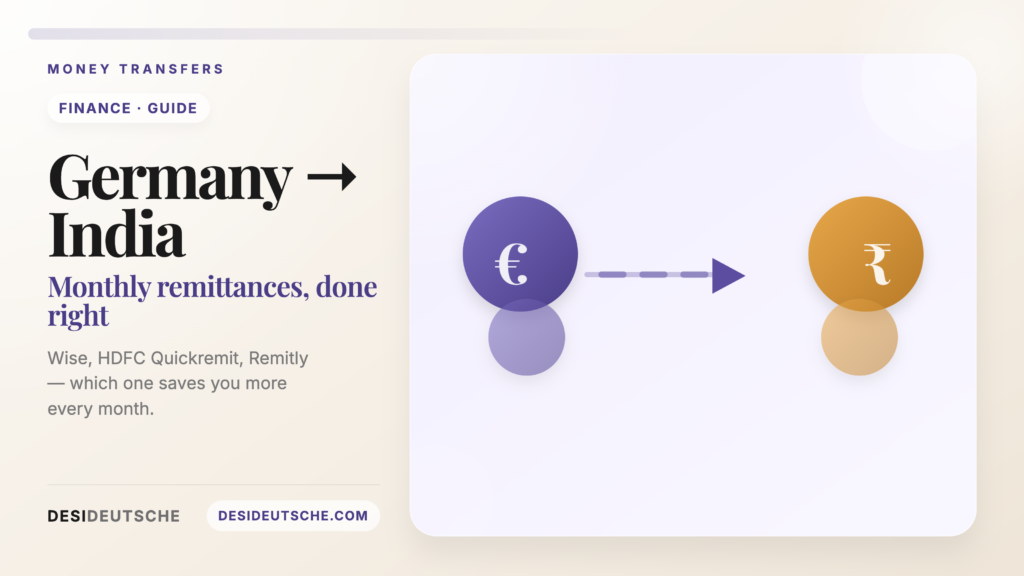
Sending money home from Germany is one of the most routine financial tasks for Indians living here, and also one of the most quietly expensive if you do it the wrong way. Whether you are transferring salary to support family, repaying a loan, or simply moving savings, the service you choose can mean the difference between losing 2 percent or 0.5 percent on every single transfer. Over a year of monthly remittances, that gap adds up to hundreds of euros.
This guide covers every realistic option for sending EUR from Germany to INR in India — with real fees, exchange rate comparisons, and guidance on when each service makes sense.
Wise: the default choice for most people
Wise uses the mid-market exchange rate and charges a fee of approximately 0.5 to 0.7 percent. For EUR to INR transfers, there is no hidden exchange rate markup — what you see on Google is what you get, minus the transparent fee. For most Indians in Germany sending between €500 and €5,000 at a time, Wise is almost always the best value.
Typical fees for EUR to INR:
| Amount (EUR) | Wise Fee (approx) | Transfer Time |
|---|---|---|
| €500 | €3–5 | Within hours to 1 day |
| €1,000 | €5–8 | Within hours to 1 day |
| €3,000 | €15–22 | Within hours to 1 day |
How to send with Wise from Germany:
- Create a Wise account at wise.com with your German phone number and ID
- Verify your identity with your passport or Personalausweis (one-time)
- Enter the amount in EUR and select INR as the destination
- Enter the recipient Indian bank account number and IFSC code
- Pay from your German bank account via SEPA transfer or debit
- Recipient receives INR directly into their Indian bank account
Remitly: strong for speed and promotional rates
Remitly is competitive with Wise for EUR to INR, and often runs promotions for new users. Its Express tier can deliver funds to Indian bank accounts within minutes, which is useful for urgent transfers. The exchange rate is slightly below mid-market but the overall cost is usually close to Wise for standard amounts.
Remitly also supports direct deposit to Indian digital wallets and cash pickup at certain locations, which gives flexibility if the recipient does not have a bank account.
HDFC Quickremit and SBI Express Remit: built for NRIs
If the recipient in India banks with HDFC or SBI, these bank-specific remittance services can be competitive, particularly for larger transfers. HDFC Quickremit and SBI Express Remit are designed for NRI remittances and offer preferential exchange rates for account holders of those banks.
When these services make sense:
- The recipient has an HDFC or SBI account in India
- You are sending large amounts regularly and want a relationship with an Indian bank
- You want transfers credited as NRE or NRO account deposits
For ad hoc transfers or when the recipient banks elsewhere, Wise or Remitly will usually be cheaper and simpler.
Direct SWIFT from your German bank: avoid for regular transfers
Sending via SWIFT directly from Deutsche Bank, Sparkasse, or DKB works but is expensive. German banks typically charge €10 to €25 per transfer for international wires, apply an exchange rate that is 2 to 4 percent worse than the market rate, and the Indian receiving bank may deduct an additional correspondent bank fee.
On a €1,000 transfer, this could cost €40 to €60 total — compared to under €10 with Wise. The only situation where bank SWIFT makes sense is if your company reimburses the fee, or if you are sending a very large amount where percentage fees would exceed fixed bank charges.
Tax and documentation: what you need to know
Germany does not tax outgoing personal remittances. You are free to send your after-tax salary to India without any German tax obligation on the transfer itself. However, keep records of large transfers — German banks are required to report transactions above €12,500 to BaFin (the financial regulator), which does not mean you are taxed but does mean the transaction is logged.
In India, money received from abroad in an NRE account is tax-free. Money received in a regular savings account from abroad is generally not taxed either, but if it generates interest or is invested, the normal Indian income tax rules apply to returns.
Full comparison: EUR to INR transfer services
| Service | Exchange Rate | Fee on €1,000 | Speed | Best For |
|---|---|---|---|---|
| Wise | Mid-market (best) | €5–8 | Hours to 1 day | Regular transfers, best value |
| Remitly | Slightly below market | €0–8 | Minutes to 3 days | Speed, first transfer promos |
| HDFC Quickremit | Competitive for large amounts | Low for HDFC recipients | 1–2 days | HDFC account holders in India |
| SBI Express Remit | Competitive for large amounts | Low for SBI recipients | 1–2 days | SBI account holders in India |
| German bank SWIFT | 2–4% below market | €25–50+ | 2–5 days | Avoid for regular transfers |
Practical tips for monthly remittances
- Set a recurring transfer: Wise allows scheduled recurring transfers. Set it once and the money goes automatically each month.
- Watch the EUR/INR rate: The rate fluctuates daily. If you are not in a hurry, transferring when the rupee is weaker (higher EUR/INR) means more rupees for the same euros.
- Keep records: Save transfer confirmations for your tax records. This is especially useful if you ever need to prove the source of funds in India.
- Combine smaller transfers: Fixed fees hurt small amounts proportionally. Transferring €2,000 once is cheaper than €500 four times.
Frequently Asked Questions: Sending Money from Germany to India
What is the cheapest way to send money from Germany to India?
Wise is the cheapest for most amounts, using the mid-market rate with a fee of 0.5 to 0.7 percent. On a €1,000 transfer you typically pay €5 to €8. Remitly is comparable and sometimes cheaper with promotional rates.
How long does it take to send money from Germany to India?
Wise typically delivers within a few hours to one business day for EUR to INR. Remitly Express delivers within minutes. Standard bank SWIFT transfers take 2 to 5 business days.
Do I need to pay tax in Germany when sending money to India?
No. Germany does not tax outgoing personal remittances. Transfers above €12,500 are reported to regulators but this is a compliance requirement, not a tax. You pay no German tax on sending your after-tax salary to India.
Is money received from Germany taxable in India?
Money received in an NRE account from abroad is tax-free in India. Money in a regular savings account from foreign remittances is also generally not taxed, but any interest or investment returns from that money are taxed normally under Indian income tax rules.
What Indian bank details do I need to send money?
You need the recipient full name, Indian bank account number, IFSC code (11-character code identifying the branch), and bank name. Most services also accept UPI ID for some delivery methods.
Can I send money to an NRE or NRO account from Germany?
Yes. Wise and most remittance services can credit Indian NRE and NRO accounts. If you specifically need NRE account credits with tax-free status, confirm the account type with the recipient before transferring.
What is the maximum I can send from Germany to India?
Germany has no general cap on outgoing personal remittances. Transfers above €12,500 are reported to BaFin. In India, the receiving end has no cap on inward remittances. Very large amounts may require source-of-funds documentation from your German bank.