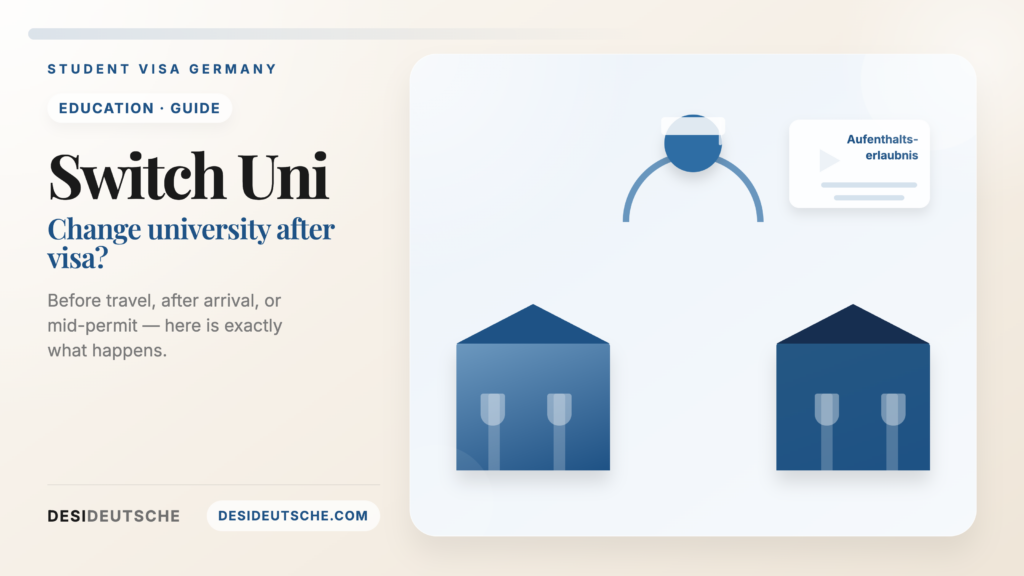
Your German student visa is tied to a specific university in your Zulassungsbescheid (admission letter). You arrived, sat in the first week of lectures, and realized the programme is not what the website promised — the research group closed, the professor left, or the course is taught in German despite the English label. Switching is allowed, but the rules depend on when you switch and what you switch to. Get this wrong and your residence permit can be revoked.
The short version
- First two semesters: you can switch relatively freely within the same subject area. The Ausländerbehörde is permissive.
- After semester 3: switching subject areas (say, Mechanical Engineering → Computer Science) usually means your visa is revoked and you reapply from scratch.
- Same subject, different university: easy at any point — this is an internal transfer (Hochschulwechsel), not a visa event.
- English-taught → German-taught programme: you need to prove German proficiency (DSH-2 or TestDaF 4). No proof, no switch.
Scenario 1: You want to switch universities, same programme
You applied to TU Darmstadt for M.Sc. Automotive Engineering, but RWTH Aachen opened a late seat for the same programme. You want to move.
Process:
- Get admission (Zulassung) from the new university.
- Submit Exmatrikulation at the old university.
- Go to the Ausländerbehörde in your new city with: new Zulassung, proof of Anmeldung at new address, blocked account (still valid), health insurance.
- They update your residence permit with the new university. No new visa needed.
Fee: €50–100 for the residence permit update. Processing time: 2–4 weeks.
Scenario 2: You want to change your subject
This is where most Indians get stuck. You started M.Sc. Data Science, but after semester 1 you want to move to M.Sc. AI or M.Sc. Software Engineering.
The Ausländerbehörde asks one question: is this a Studienfachwechsel (subject change) or a Studiengangwechsel (programme variant change)?
- Same subject area (Data Science → AI, both in Informatik): usually approved. You may lose 1–2 semesters of credit.
- Different subject area (Mechanical Engineering → Business): rarely approved after semester 2. You will be told to return to India and reapply.
Your credit transfer is handled by the new programme’s examination office (Prüfungsamt), not the visa office. Ask for a written credit-transfer plan before you submit the switch to the Ausländerbehörde — otherwise they assume you are restarting a 4-semester Master’s, which extends your visa clock.
Scenario 3: You want to drop out entirely
If you exmatriculate without a new Zulassung, your student residence permit becomes invalid on the date of exmatriculation. You get a 6-month grace window (Aufenthaltstitel zur Arbeitsplatzsuche) to find a job only if you already completed a German degree. Partial study does not qualify.
If you did not complete the degree, you must either: find a new admission fast, switch to a different residence purpose (Ausbildung, work visa via a job offer, family reunion if applicable), or return to India.
What the Ausländerbehörde actually checks
- Study progress: have you earned enough ECTS per semester? The rule of thumb is 30 ECTS per semester; falling below 18 triggers questions.
- Total study time: you cannot spend more than the programme’s standard duration plus 2–3 semesters. A Master’s has a 4-semester Regelstudienzeit — that gives you 6–7 semesters maximum before they refuse to renew.
- Financial proof: your blocked account must still cover living costs for the remaining duration.
Mistakes I have seen Indians make
- Switching too late: changing subjects in semester 3 almost always ends in visa revocation. Decide in semester 1 if the programme is wrong.
- Not formalising the switch: students exmatriculate hoping to enrol elsewhere “next semester” and their permit expires in between. There is no grace period for gaps.
- Assuming English programmes waive German requirements: if you want to move to a different university, the new programme’s language rules apply, not your old one’s.
- Forgetting the blocked account: the funds are tied to your original residence permit. Switching triggers a re-verification — make sure the balance is above the threshold (€11,904 for 12 months as of 2026).
Timeline: if you want to switch in the coming semester
- Now to application deadline: apply to the new programme (Uni-Assist if external applicant, internal application form if same university).
- On receiving Zulassung: immediately email your current university to initiate exmatrikulation and request a Studienverlaufsbescheinigung (study progress certificate).
- Before exmatrikulation takes effect: book your Ausländerbehörde appointment. Bring old Zulassung, new Zulassung, study progress, proof of funds, Anmeldung.
- After the switch: update your health insurance and, if you moved cities, re-register your address within 14 days.
What about switching to work?
If you have a job offer mid-programme, you can switch to a Blue Card or work visa — but you lose student benefits (semester ticket, cheaper rent in student housing) and your clock for permanent residency resets to the work-visa track. It is usually worth finishing the degree unless the offer is exceptional.
Bottom line
Switching universities is almost always fine. Switching subjects is risky after semester 2. Switching out of study entirely is the biggest visa trap — plan the next step before you exmatriculate, not after.