Thinking about moving to Germany for studies, work, or a fresh start?
While Germany is known for its free education and excellent quality of life, many newcomers are surprised by the housing challenges they face. The rental market can be competitive, costly, and quite different from what you might expect.
That’s why it’s important to be prepared. In this guide, you’ll learn how to find the right housing in Germany — including types, costs, trusted platforms, required documents, and tips to avoid scams.
🧭 Types of Housing in Germany
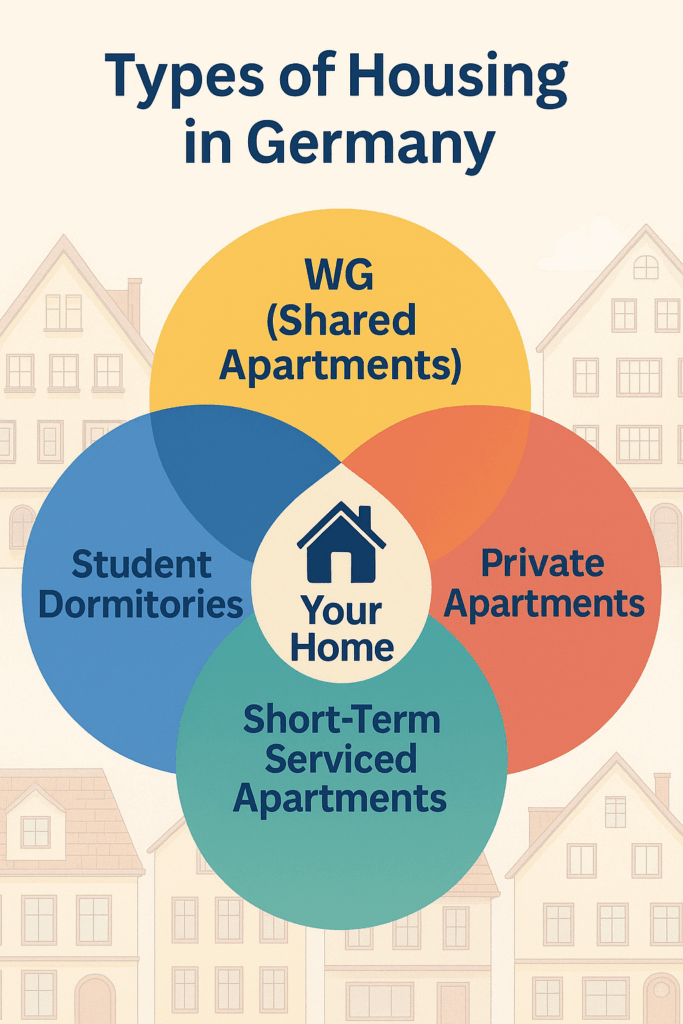
Understanding the types of housing available in Germany is the first step toward making an informed decision. Each type comes with its own advantages, costs, and lifestyle implications.
1. WG (Wohngemeinschaft) – Shared Apartments
WG stands for “Wohngemeinschaft,” meaning shared housing. This is one of the most common and affordable options for students and young professionals. You rent a private room and share the kitchen and bathroom.
Monthly rent usually ranges from €300 to €550, depending on the city.
👉 Tip: Use WG-Gesucht.de to find shared rooms all over Germany. It’s fast, reliable, and widely used by locals and expats.
2. Student Dormitories (Studentenwohnheim)
These are managed by the university’s “Studierendenwerk” and often have long waiting lists. However, they are well-priced and often come with utilities included.
Expect to pay between €200 and €400 per month. Most dorms offer single rooms with shared kitchens or bathrooms.
👉 Visit Studierendenwerk for dorm options in your city.
3. Private Apartments
If you prefer more privacy, renting your own apartment is a good option. These are more expensive and usually come unfurnished, sometimes without even a kitchen.
Rent for private apartments typically starts at €700 and can go up to €1,500, especially in cities like Munich or Frankfurt.
👉 Use Immobilienscout24.de or eBay Kleinanzeigen for private listings.
4. Short-Term Serviced Apartments
These are perfect for your first month in Germany. Fully furnished and available on a monthly basis, they offer flexibility and comfort while you search for something long-term.
Platforms like Wunderflats, Spotahome, and Homelike specialize in short-term rentals for expats.
💶 Rent Costs by City
Here’s a rough estimate of rental costs in Germany’s major cities:
| City | Shared Flat (WG) | Private Apartment |
|---|---|---|
| Berlin | €450 – €700 | €800 – €1,300 |
| Munich | €550 – €800 | €1,000 – €1,500 |
| Leipzig | €300 – €450 | €500 – €850 |
| Jena | €350 – €500 | €600 – €900 |
| Hamburg | €450 – €750 | €850 – €1,300 |
Note: Most rents exclude utilities (“Nebenkosten”), which can add €100–€250 monthly.
🔍 Where to Search for Housing
To find housing successfully, you need to combine multiple sources — official platforms, social media, and local communities.
📌 Online Platforms:
- WG-Gesucht.de – Best for shared flats
- Immobilienscout24.de – Best for full private rentals
- Studierendenwerk – University-run dormitories
- eBay Kleinanzeigen – For all types of housing (be cautious)
💬 Facebook & WhatsApp Groups:
In addition to websites, many locals post in Facebook housing groups and private WhatsApp networks. These platforms are very active, especially among students and expats.
Look for:
- “WG Zimmer Berlin”
- “Apartments for Rent in Munich”
- “Indians in Germany Housing”
- City-specific WhatsApp housing groups (ask university peers or seniors to add you)
👉 Tip: Set alerts and act fast — good listings often disappear within hours.
📑 Documents You’ll Need
To apply for housing, you’ll typically need:
- Valid passport or residence permit
- Proof of income (or blocked account for students)
- SCHUFA credit report (not needed for short-term or student rentals)
- Bürgschaft (a guarantor letter, if you don’t have income)
- University enrollment letter (if applicable)
Being prepared with these documents will increase your chances of getting approved.
⚠️ Avoiding Rental Scams
While platforms like WG-Gesucht are trustworthy, scams are common — especially in Facebook and WhatsApp groups.
❌ Warning Signs:
- Landlord says they’re abroad and can’t show the apartment
- Asks for money via Western Union or PayPal before signing a contract
- Offers that seem “too good to be true” in big cities
✅ Stay Safe:
- Never pay anything before verifying the property
- Use verified platforms or agencies
- Insist on a signed contract before transferring money
🕒 When to Start Looking
It’s best to start your housing search at least 2–3 months in advance.
For students:
- August and September are highly competitive months.
- Apply for student dorms as early as possible — some fill up 6+ months in advance.
For professionals:
- Plan a temporary stay (e.g., 1 month) while you look for something long-term locally.
✅ Final Thoughts: Be Early, Be Prepared, Be Smart
Finding the right housing in Germany isn’t impossible — but it does take time, effort, and a bit of flexibility. By starting early, using trusted platforms, and tapping into Facebook and WhatsApp communities, you can greatly increase your chances of success.
So take your time, be prepared, and reach out to people — your ideal home might be one message away.
💡 Next Reads
Hidden Costs of Living in Germany (2025): How to Save!
Is Education Really Free in Germany?

Nursing & Caregiver Route to Germany for Indians: §16d and Triple-Win Explained
Germany has a severe, structural nursing shortage. By 2030 the country needs an additional 500,000 nurses. The government opened the visa pipeline specifically to attract trained nurses from India, the Philippines, and Vietnam. For an Indian nurse with a B.Sc.…
Au Pair in Germany for Indians: The Cheapest Route In (Under 26)
The Au Pair programme is the cheapest legal way for an Indian to live in Germany. You move in with a host family for 6–12 months, help with childcare and light housework 25–30 hours a week, and in return you…
Ausbildung in Germany for Indians: The Paid Vocational Training Route (2026)
Ausbildung is Germany’s dual vocational training system — you work at a company 3–4 days a week, attend a Berufsschule (vocational school) 1–2 days a week, and get paid €900–1,400/month while you learn. After 2–3.5 years you receive a German…
German Freelance Visa (Freiberufler) from India: Who Qualifies and How to Apply
If you are an Indian designer, developer, writer, consultant, photographer, or architect, the German Freelance Visa (Aufenthaltserlaubnis für selbständige Tätigkeit, §21.5 AufenthG) lets you move to Germany without a job offer and without a university place. It is paperwork-heavy, takes…
Chancenkarte for Indians: The Full Points Calculator and Application Guide (2026)
The Chancenkarte (Opportunity Card, Chancenkarte nach §20a AufenthG) is Germany’s newest visa, introduced in June 2024 specifically to pull skilled workers from non-EU countries. For Indians it is arguably the best route: 12 months to job-hunt on the ground, legal…